Why Holding Your Own Bitcoin Matters
"Not Your Keys, Not Your Bitcoin"
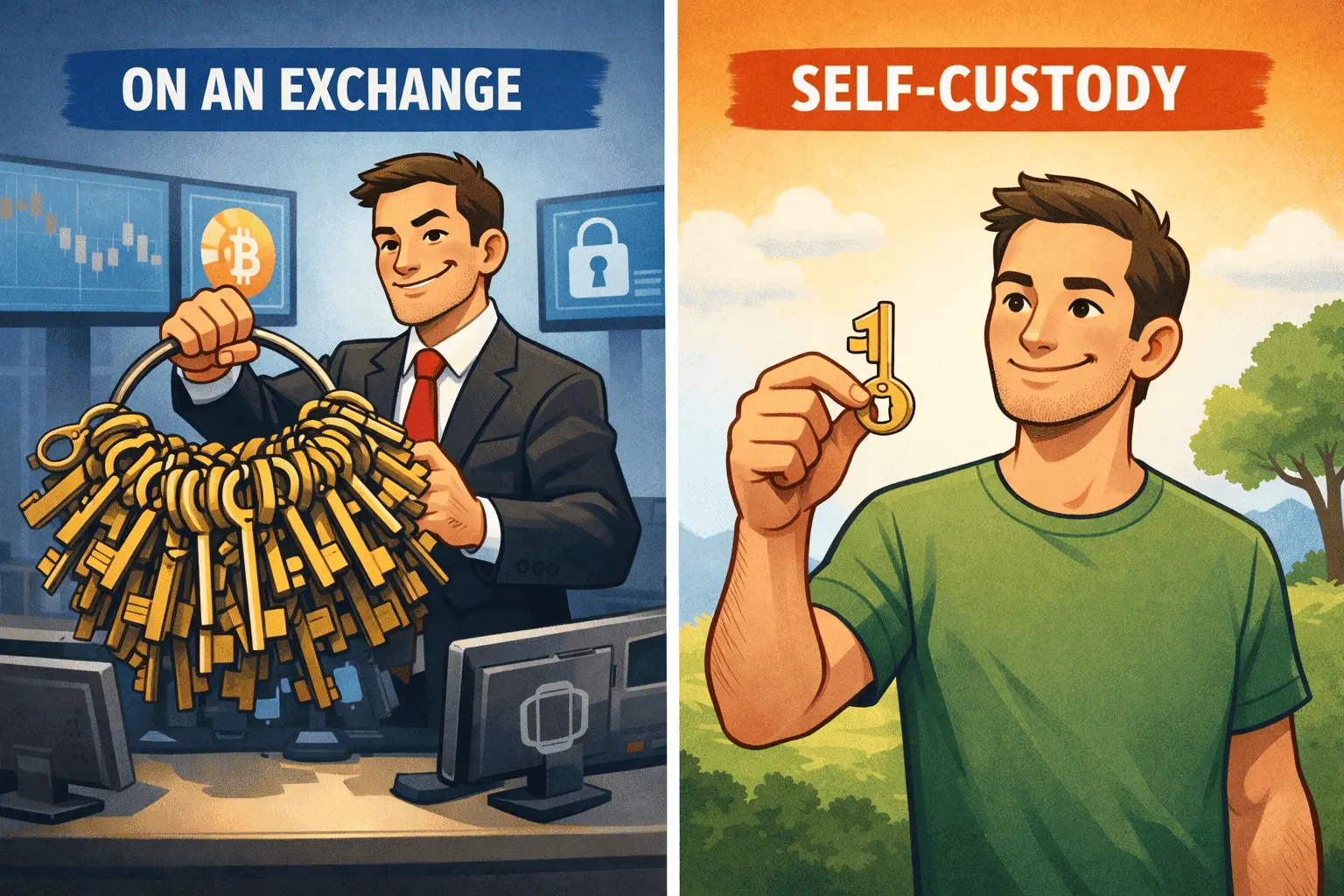
If you don't control the private keys, you don't truly own the Bitcoin.
This phrase became popular because many people buy Bitcoin on exchanges and never withdraw it. In that case, the exchange holds the keys, NOT you.
Think of it like this:
You may see a balance on your screen, but what you actually have is a promise from the exchange to give you Bitcoin later.
A Simple Analogy
Imagine a safe filled with gold.
- The safe is your wallet
- The gold is your Bitcoin
- The key is your private key
If someone else holds the key, you are trusting them to give you access when you ask.
Self-Custody means you hold the key yourself.
What Happens When You Use an Exchange?
When Bitcoin stays on an exchange:
- The exchange controls the private keys
- Withdrawals can be paused
- Accounts can be frozen
- Funds can be lost due to hacks or bankruptcy
History has shown this risk many times. Even large, well-known platforms have failed.
Notable Exchange Failures
| Exchange | Year | What Happened | Amount Lost |
|---|---|---|---|
| Mt. Gox | 2014 | Hacked/mismanaged | 850,000 BTC |
| QuadrigaCX | 2019 | Founder died with keys | $190 million |
| FTX | 2022 | Fraud/misappropriation | ~$8 billion |
| Celsius | 2022 | Bankruptcy | $4.7 billion |
| BlockFi | 2022 | Bankruptcy | Significant losses |
These weren't obscure platforms. They were trusted by millions.
The common factor: customers didn't hold their own keys.
The Trade-Off
Some people choose exchanges for convenience. That's understandable, especially when starting out.
But it's important to understand the trade-off:
| Exchange Custody | Self-Custody |
|---|---|
| Convenient | Requires learning |
| Someone else's responsibility | Your responsibility |
| Can be frozen/seized | Cannot be frozen |
| Subject to hacks | Only you control access |
| Counterparty risk | No counterparty risk |
Convenience means giving up control.
Ownership means taking responsibility.
True Bitcoin ownership begins when you withdraw your coins to a wallet you control.
Why This Matters for Bitcoin
Bitcoin was created to work WITHOUT trusted intermediaries.
As described in the Bitcoin whitepaper:
"A purely peer-to-peer version of electronic cash would allow online payments to be sent directly from one party to another without going through a financial institution."
When Bitcoin is left on exchanges, the system starts to look like traditional banking again—just with different companies in control.
Self-custody keeps Bitcoin aligned with its original purpose.
"But Exchanges Are Insured..."
Some exchanges advertise insurance. Be careful:
- Insurance often covers only a fraction of holdings
- It may not cover all types of loss (e.g., fraud vs. hack)
- Claims processes can take years
- You might get dollars back, not Bitcoin (at original price)
- Insurance companies can deny claims
Insurance is not a substitute for self-custody.
"But I Might Lose My Keys..."
This is a valid concern. People do lose access to their Bitcoin through poor key management.
The solution isn't to trust someone else with your keys. The solution is to learn proper backup practices:
- Write down your seed phrase correctly
- Store it securely (metal backup recommended)
- Test your backup before depositing significant funds
- Consider geographic redundancy
With proper practices, self-custody is safer than exchange custody.
→ See: Backup Verification Guide
When to Move to Self-Custody
There's no universal threshold, but consider these guidelines:
| Situation | Recommendation |
|---|---|
| Learning with tiny amounts | Exchange is temporarily acceptable |
| More than a few hundred dollars | Start learning self-custody |
| Amount that would hurt to lose | Self-custody strongly recommended |
| Life-changing amount | Self-custody required |
The right time is before you need it. Don't wait for an exchange failure to learn self-custody.
How to Get Started
Ready to take control of your Bitcoin?
-
Assess your threat model — What level of security do you need?
-
Choose your setup — Find the right approach
-
Set up a hardware wallet — The standard recommendation
-
Verify your backup — Test before you trust
-
Review the checklist — Before moving significant funds
Key Takeaways
- Your keys = your Bitcoin. Someone else's keys = their Bitcoin.
- Exchanges have failed repeatedly, losing billions in customer funds
- Convenience isn't worth the counterparty risk for significant amounts
- Proper self-custody is learnable and safer than trusting third parties
- The time to learn is before you need it
Continue Learning
→ Next: Choose Your Setup — Find the right self-custody approach
→ Deep Dive: Private Keys Explained — Understand the technical foundation
→ Action: Hardware Wallet Setup — Start self-custodying today