Why Holding Your Own Bitcoin Matters
By the end of this page you'll understand why the phrase "not your keys, not your coins" is more than a slogan, what actually happens when your bitcoin sits on an exchange, and when the right moment is to move your coins into a wallet you control.
"Not your keys, not your Bitcoin." If you don't control the private keys, you don't truly own the coins, no matter what the balance on your screen says.
This phrase exists because a huge number of people buy bitcoin on an exchange and then leave it there, assuming the balance they see is the coins they bought. It isn't. The exchange is holding the actual coins behind the scenes, and what you're holding is a promise from that exchange to give you some bitcoin whenever you ask. As long as the promise holds, the two things look identical from the outside. The moment it doesn't, the difference between them becomes the only thing that matters.
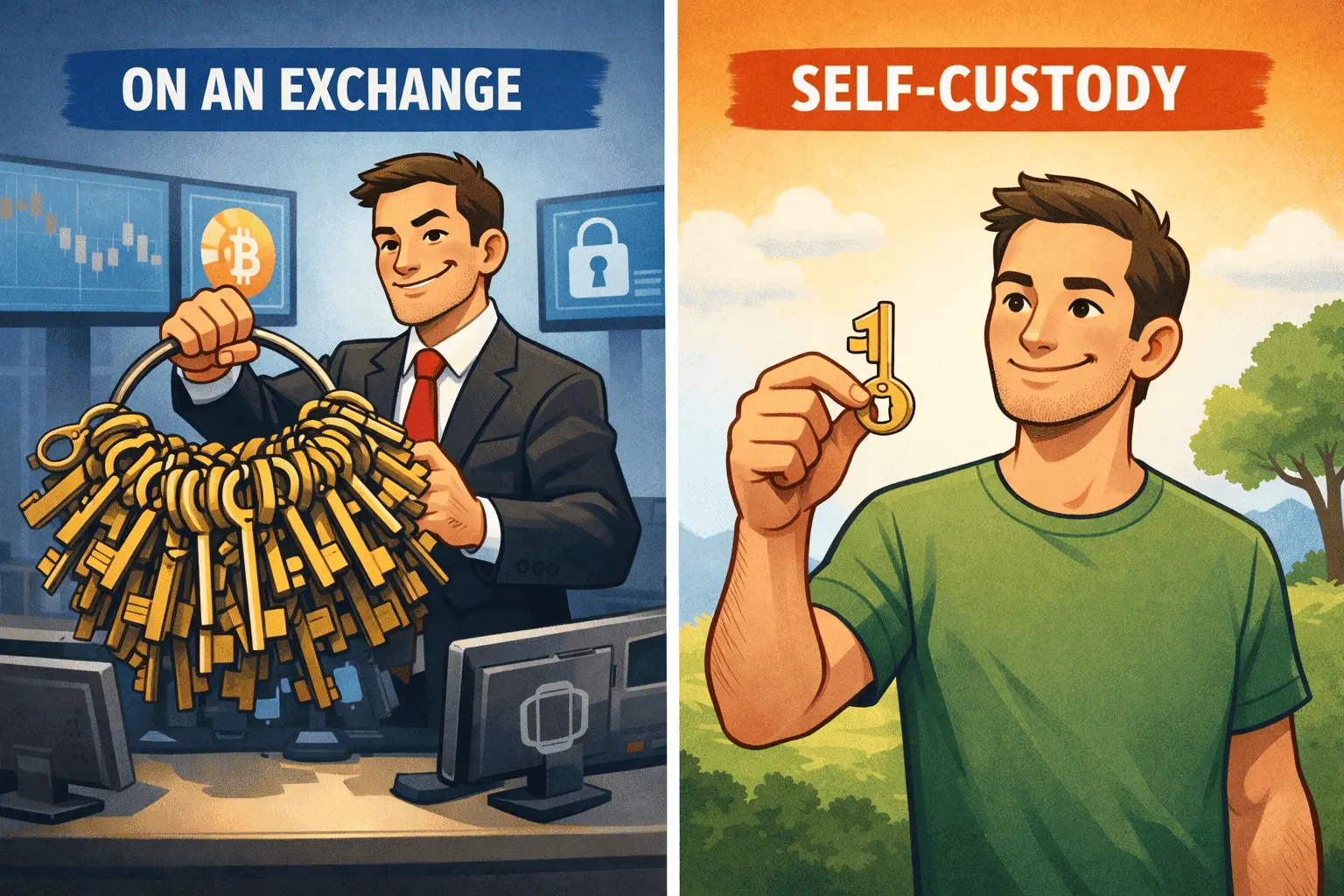
Imagine a safe filled with gold bars. The safe is your wallet, the gold is your bitcoin, and the key is your private key. If someone else is holding that key, what you really have is their word that they'll let you open the safe whenever you show up at the door. Self-custody means you're the one holding the key, and nobody gets to decide for you whether the safe opens today.
What actually happens when you leave bitcoin on an exchange
When your coins sit on an exchange, the exchange is the real holder of the private keys, which means the exchange is the real owner of the coins in every way that counts. Your withdrawal can be paused at any time, for any reason the exchange decides is good enough, because they are the ones signing the on-chain transaction, not you. Your account can be frozen by a compliance team, a court order, or a routine fraud review that takes a few weeks to clear. Your funds can be lost in a hack you had no way to prevent, or disappear into a bankruptcy proceeding that takes years to unwind. None of this requires bad intent on anyone's part. It's how custodial platforms work by design.
History has made this point repeatedly, and not with obscure backwater platforms. The five collapses below were all large, well-known exchanges trusted by millions of customers at the moment they failed.
| Exchange | Year | What happened | Amount lost |
|---|---|---|---|
| Mt. Gox | 2014 | Hacked and mismanaged over years | ~850,000 BTC |
| QuadrigaCX | 2019 | Founder died, allegedly taking the keys | ~$190 million |
| Celsius | 2022 | Froze withdrawals and filed for bankruptcy | ~$4.7 billion |
| FTX | 2022 | Customer funds misappropriated as fraud | ~$8 billion |
| BlockFi | 2022 | Bankruptcy following the FTX collapse | Significant |
Mt. Gox was the largest Bitcoin exchange in the world when it imploded and the loss was so large it still weighs on the market a decade later. QuadrigaCX's founder, according to the bankruptcy proceedings, was the only person with access to the keys, and when he died the coins went with him. FTX was a blue-chip platform with celebrity endorsements and a stadium naming deal right up to the moment its customer funds turned out to have been quietly moved to a sister company and gambled away. Celsius and BlockFi were both large lending platforms that froze customer withdrawals and filed for bankruptcy in the same cascade.
The customers of every single one of those platforms had one thing in common, which is that none of them were holding their own keys. If they had been, none of those collapses would have touched their coins.
The trade-off you're actually making
Plenty of people still use exchanges for convenience, and there's nothing irrational about that when you're starting out, because moving your first few dollars of bitcoin into a proper wallet feels harder than it should. The real trade-off is worth naming plainly so you can make the choice with your eyes open.
Exchange custody is convenient, in the sense that somebody else handles the keys, the backups, the security, and the mistakes. It's also somebody else's responsibility, which sounds like a win until you remember that "somebody else's responsibility" is another way of saying "you have no recourse when they fail". Your balance can be frozen, your account can be seized, and your coins are exposed to every hack and every bankruptcy that touches the platform. Self-custody flips all of that. You take on the learning curve and the responsibility in exchange for coins that cannot be frozen, cannot be seized through the exchange, and carry no counterparty risk because there is no counterparty.
Convenience means giving up control. Ownership means taking responsibility. True Bitcoin ownership begins the moment you withdraw your coins to a wallet you control.
Why this matters for Bitcoin as a whole
Bitcoin was designed from the start to work without trusted intermediaries, which is the entire point of the system. That design choice wasn't an accident or a technical flourish. It was the motivating idea of the original whitepaper.
"A purely peer-to-peer version of electronic cash would allow online payments to be sent directly from one party to another without going through a financial institution."
When people leave their bitcoin on exchanges, the system quietly re-creates the thing it was built to avoid. The intermediaries have different names and different logos, but the structure is the same: a small number of companies sit between users and their money, and those companies can be regulated, compromised, or pressured like any other bank. Self-custody is what keeps Bitcoin aligned with the original idea, because it's the mechanism that makes "peer-to-peer electronic cash" an actual description rather than a nice phrase.
What about exchange insurance
Some exchanges advertise insurance policies, and the marketing copy often sounds reassuring enough that people assume their funds are as safe as money in a bank account. That assumption is worth examining carefully before you rely on it.
Exchange insurance policies almost always cover only a fraction of total customer holdings, because insuring the full balance sheet of a platform holding billions of dollars in bitcoin would cost more than any exchange is willing to pay. The policies typically cover specific events such as an external hack of the exchange's hot wallet, and they typically exclude the things that have actually destroyed exchanges in practice, such as internal fraud, mismanagement, and bankruptcy. When a claim does succeed, the process can take years to resolve, and the payout is almost always denominated in dollars at the price the coins had on the day of the incident, not in the bitcoin you originally held. In other words, even the best-case outcome leaves you without any of the bitcoin you thought you owned. Insurance is not a substitute for self-custody. It's a partial cushion for one particular kind of failure, and the other kinds of failure are the ones that have cost people the most.
What about losing your own keys
This is a fair concern, and it's the one objection to self-custody that deserves a serious answer rather than a pep talk. People do lose access to their bitcoin through poor key management, usually by storing a seed phrase somewhere fragile and then losing the paper, or by writing it down incorrectly and never testing that the backup actually works.
The answer isn't to hand your keys to someone else and hope they do a better job. The answer is to learn the small handful of backup practices that turn self-custody from "risky" into "safer than an exchange". Write down your seed phrase carefully, word by word, on something durable (a metal backup plate is the standard recommendation because paper burns and ink fades). Store the backup somewhere only you can reach it, and consider keeping a second copy in a physically separate location so a single fire or flood can't take both at once. Most importantly, test your backup by restoring from it on a fresh wallet before you put any significant amount of bitcoin into the original, because an untested backup is a guess. The Backup Verification Guide walks through this process step by step. With these practices in place, self-custody is genuinely safer than leaving your coins on even the best-run exchange.
When to move to self-custody
There's no universal threshold where self-custody suddenly becomes mandatory, but there are a few useful reference points that help most people find the right moment. If you're holding a tiny amount purely to learn how Bitcoin works, leaving it on a reputable exchange for a short time is a defensible starting point because the learning benefit is real and the potential loss is small. Once you're past a few hundred dollars, it's time to start learning self-custody in earnest, because the amount is now large enough that a platform failure would actually hurt. Once you reach an amount you would genuinely be upset to lose, self-custody stops being optional and becomes the right answer, and once you're holding a life-changing amount, the only responsible move is to hold it yourself with a hardware wallet and a tested backup.
The best time to learn self-custody is before you need it, not after. Waiting for an exchange collapse to teach you the lesson is the one way to learn it that will actually cost you money.
How to get started
If you're ready to take control of your bitcoin, the next steps are straightforward and they build on each other.
- Read Assess Your Threat Model to figure out what level of security actually fits your situation, because the right answer for someone holding pocket money is not the right answer for someone holding their retirement.
- Work through Choose Your Setup to pick the approach that matches your threat model without over-engineering it.
- Follow the Hardware Wallet Setup guide, which is the standard recommendation for anyone holding a meaningful amount of bitcoin.
- Run through the Backup Verification process and actually test your recovery, because a backup you haven't tested is a backup you're guessing about.
- Before you move any significant amount of money onto your new wallet, go through the Before You Deposit checklist once, because catching a problem here is vastly cheaper than catching it after the fact.
Where to go next
The most natural next step is Choose Your Setup, because it turns the ideas on this page into a concrete decision about which tools you're going to use. If you'd rather see the technical foundation first, Private Keys Explained shows how ownership actually works at the level of the keys themselves, and the Hardware Wallet Setup guide is waiting for you whenever you're ready to move from theory to a device in your hand.